This post has been in the drafts folder for a long time. I originally planned to post it while we were still in Korea, but time got away from us. So now it's
finally time to talk about that main task you do when you spend a lot of time in another country that uses a different language than your own native tongue. Yes, learning the language.
I first learned about Korean in grade six socials studies when my teacher, who had recently returned from a year working with SDALI in Korea, did a unit on South Korea. I don't think we really learned much of the language, just how to say hello, goodbye, and a few other basic phrases and food names. But the one thing I did learn and remember was that Korea's written language contains an awful lot of Os. I didn't really think about it much until I read the book
Naomi: The Strawberry Blonde of Pippu Town in grade eight or nine (still one of my favourites and the start of my love-affair with all things Japanese - but more on that in a future post). From that book I learned so much about Japan and even a little bit about the written Japanese and Chinese languages.* Once knowing that, I found it pretty easy to differentiate between Chinese (crazy-looking), Japanese (quite a bit less crazy-looking), and Korean (lots of Os), and have since used my self-created system whenever I find myself looking at one of those three northern Asian written languages.
Fast-forward to early November 2011 when we arrived in South Korea. We could easily tell that the writing we saw everywhere was Korean (we were in Korea and there were lots of Os). But we still had absolutely no idea what anything said. I had found a Lonely Planet Korean phrasebook before leaving the US, but we hadn't done much more than look up 'thank you' with it until our
Busan trip during Christmas break. There I decided it was high time I at least try to start learning to read
Hangul, the written Korean language. So I broke out the book and started studying the 24-character alphabet. And after one short session I had pretty much all the consonants down pat. Another session firmly secured them in my mind. Then it was time to move on to the vowels. But there I got bogged down. I learnedㅏ(ah) andㅣ(ee) and that was where my brain ground to a halt. So, during my Busan studies I learned all 14 consonants and 2 of the 6 regular vowels. Not terrible for a beginner, but nothing too boast-worthy. Although I was able to figure out a few whole words from that, it wasn't too helpful in my daily life.
So fast-forward again to our next term break to
Jeollabuk-do. There I resumed my Hangul studies, and this time decided to at least learn the rest of the regular vowels. Jonathan got on board, too, and we helped each other figure out the vowel sounds. I even dabbled in trying to figure out the vowels with the W and Y sounds attached, but those were still pretty hard for me. In the end, we were able to figure out quite a few words by piecing together the consonants and the regular vowels, with a little double-checking in our phrasebook (motel - 모텔 - turned out to be one of the easier words to identify, mostly because of its prevalence in Korean towns).
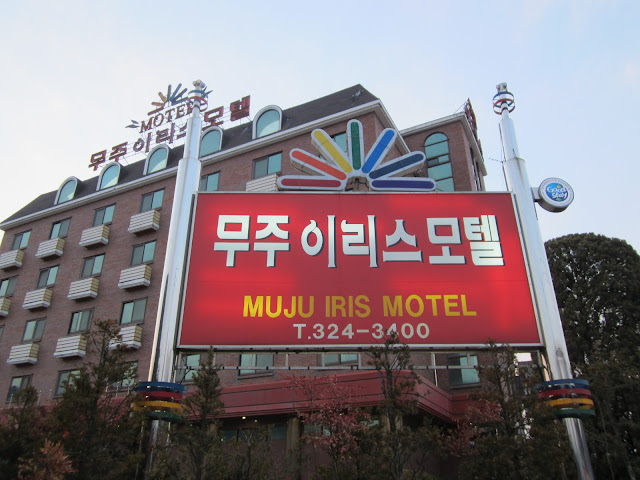 |
| Can you spot 'motel' in Hangul? |
Let's fast-forward another month to when Jonathan and I were invited to join the church choir at Seoul Main. The choir sang in Korean and during the first few practices we attended, we had to ask willing choir members to help us transliterate the Hangul symbols to English sounds. After a couple weeks of that, we realized that we really just needed to once and for all learn Hangul ourselves. So we worked to do the transliterations for ourselves. Ironically, right about that time, Jonathan happened across a series of pictures that one of his friends had posted on Google+. The pictures completely simplified the whole process of learning written Korean. Jonathan saved the pictures on his computer and also put them on his phone. Then, whenever we ran into a problem with transliterating our choir songs, we double-checked the sounds in question with the pictures. Consequently, our Hangul abilities grew in leaps and bounds, and soon we were quickly writing in the English sounds for the songs within minutes.
 |
| Transliteration from Hangul to English |
 |
| Cheat sheet from our first time singing with the church choir (on a communion week, no less) |
And now we're sharing those pictures with you. Take a look at how anyone can learn Hangul in 15 minutes!
*Here's what
Wikipedia says about Japanese: The Japanese language is written with a combination of three scripts: Chinese characters called kanji (漢字), and two syllabic (or moraic) scripts made of modified Chinese characters, hiragana (ひらがな or 平仮名) and katakana (カタカナ or 片仮名). The Latin script, rōmaji (ローマ字), is also often used in modern Japanese, especially for company names and logos, advertising, romanization of Japanese characters, and when entering Japanese text into a computer. Arabic numerals are generally used for numbers, but traditional Sino-Japanese numerals are also commonplace (see Japanese numerals).


